Why a used car is not selling and how to check price, advert and demand
Used car getting no enquiries? A guide for dealers on checking price, photos, equipment, listing category and demand for the model in the region.
In this article
Key findings
- A used car most often stays unsold for one of four reasons: it is more expensive than comparable cars and the advert does not explain why, the gallery and description do not answer buyers' questions, incorrect data keeps it out of search filters, or there is no demand for that version in the region.
- The advert's performance shows where interest is being lost. If it gets few impressions, the cause is usually the listing category or weak demand. If it appears in results but people do not open it, the problem is the main photo or the price. If people read the listing but do not get in touch, content is missing or the price is wrong. And if viewings do not end in a sale, the car does not match the advert.
- A price cut only helps if the cheaper cars really are comparable, meaning the same generation, the same engine and transmission and similar mileage. It will not fix a filter error or weak photos.
- Demand varies by market and by powertrain. In Italy, petrol hybrids accounted for 12% of used car ownership transfers in September 2026, while electric cars made up 1.4%. In Germany, electric cars have accounted for 5% of used car ownership transfers since the start of 2026.
- Whether changes are working is shown by the ratio of enquiries to listing views and by days advertised compared with the same segment. Among the listings on German portals, cars were advertised for an average of 56 days in September 2026.
A dealer starts asking why a used car is not selling when comparable cars in nearby listings disappear while their own car keeps tying up capital and adding days in stock. The first reaction tends to be a price cut, but the cause often lies elsewhere: the car does not appear under the right filters, the main photo does not catch anyone's eye, the description does not answer basic questions, or there is simply no demand for that version in the region. A diagnosis therefore has to follow the buyer's entire journey, from the search results to the viewing, and compare each step with the market.
Why a used car is not selling: where buyers lose interest
The first step is to find out at which point interest stops. Either buyers do not see the offer at all, or they see it but do not open it, or they read it but do not contact the seller, or they make contact and then go no further. Each of these situations calls for a different remedy.
| What the results show | Likely cause | What to do first |
|---|---|---|
| The advert rarely appears in search results | Wrong category, incorrect specifications or weak local demand | Correct the category and the data buyers filter by |
| The offer appears, but few people open the listing | Weak main photo, a price above nearby offers or an unclear title | Replace the main photo and compare the price with comparable cars |
| People read the listing, but no enquiries come in | Incomplete gallery, missing history, unclear price or equipment | Add the missing information and state an unambiguous price |
| Enquiries come in, but no viewings are arranged | Slow replies, unanswered questions or an offer that does not meet expectations | Speed up the sales team's responses and make the description more precise |
| Viewings take place, but no sale follows | Condition of the car, undisclosed faults, discrepancies with the advert | Bring the advert into line with the car's actual condition |
Few enquiries, then, do not necessarily mean that the car is overpriced. If it is missing from the automatic transmission filter, no price cut will put it in front of the customers who are searching for exactly that.
For stock running to dozens or hundreds of cars, Stock Report from Carsdata speeds up this diagnosis. It compares stock with the market and flags the cars that need action, whether that means repricing, adding missing equipment to the advert, new photos or a corrected category. The sales team then does not have to start every car off with the same blanket discount.
1. Is the car correctly categorised and can it be found at all?
Start with the data buyers filter by. Make and model are not enough: if the transmission, drivetrain, body style or power output is listed incorrectly, the car drops out of the selection before the buyer even starts comparing prices.
A common mistake is a mismatch between the free text and the portal's structured fields. Automatic climate control mentioned only in the description is no help to a customer who has selected it as a filter. The same goes for a tow bar, all-wheel drive or driver assistance systems: anyone filtering for all-wheel drive will not see a four-wheel-drive car if that field has not been filled in.
The advert must therefore correctly state:
- generation, body style, and engine including power output;
- fuel and the exact type of hybrid system;
- transmission and driven wheels;
- year of manufacture or first registration, in the correct field;
- mileage that matches the photo of the instrument cluster and the documentation;
- equipment entered in the portal's fields, not just in the description;
- the same details for the same car across all advertising channels.
Incorrect data also attracts the wrong prospects. A car advertised as a full hybrid that is in fact a mild hybrid (a system in which the electric motor only assists the combustion engine) will draw visitors, but they leave once the difference has been explained. A high number of clicks then hides the fact that the traffic is of poor quality.
2. Is the price in line with comparable cars?
Compare the price with the offers the same customer is choosing from. A Golf of a different generation, with a different engine or transmission or with markedly different mileage may cost about the same, but it does not belong in the comparison.
A comparable car has the same generation and body style, similar age and mileage, the same drivetrain and transmission, and similar condition and equipment. The region of sale and the terms of the offer also play a part: a price conditional on finance cannot be compared directly with an unconditional one, and the comparison is equally distorted if one offer quotes a price including VAT and the other excludes it.
A price above comparable cars also directly reduces visibility. When buyers sort results by price, the car moves further down and many of them never get as far as seeing it.
Illustrative example: a dealer is offering a car for €22,000, while comparable offers of the same generation, with the same engine and transmission and similar mileage, cost around €20,000. Buyers will only accept the €2,000 difference if they can see a reason for it, such as lower mileage, better condition or valuable equipment. That reason, however, has to be shown in the advert, both in the description and in the photos. The fact that the dealer paid a lot for the car is not a reason.
Three rules are worth following when reading the market:
- The cheapest offer is rarely a good price anchor. The car may be in worse condition, the price may not be complete or different commercial terms may apply.
- Expensive offers that stay online for a long time do not confirm the achievable price. Often these are precisely the cars that are not selling.
- A disappearing advert does not reveal the price at which the car finally sold. The listing does not show what discount it went for.
How to derive the selling price and buying limit from the market is covered in the article How to price a used car: from market selling price to buying limit.
3. How to make a used car advert more appealing
The photos must answer the buyer's questions
Some portals require only three different photos, but such a minimum is not enough to sell a car. The gallery should cover all the areas listed in the table. A well-equipped car or a car with faults needs more detailed shots, whereas several photos of the same side add nothing new.
| Part of the gallery | What it should show | What the buyer is missing without the shot |
|---|---|---|
| Exterior | The whole car from all sides, the wheels, the condition of the bodywork | An overview of appearance and damage |
| Interior | Front and rear seats, dashboard, controls | The condition of the upholstery and the layout of the cabin |
| Instrument cluster | Readable mileage | A way to verify the figure in the advert |
| Boot | Space and condition of the trim | An idea of practicality and wear |
| Valuable equipment | Features that set the car apart from cheaper offers | The reason for the price difference |
| Faults | Damage in close-up and on the whole panel | Realistic expectations before the viewing |
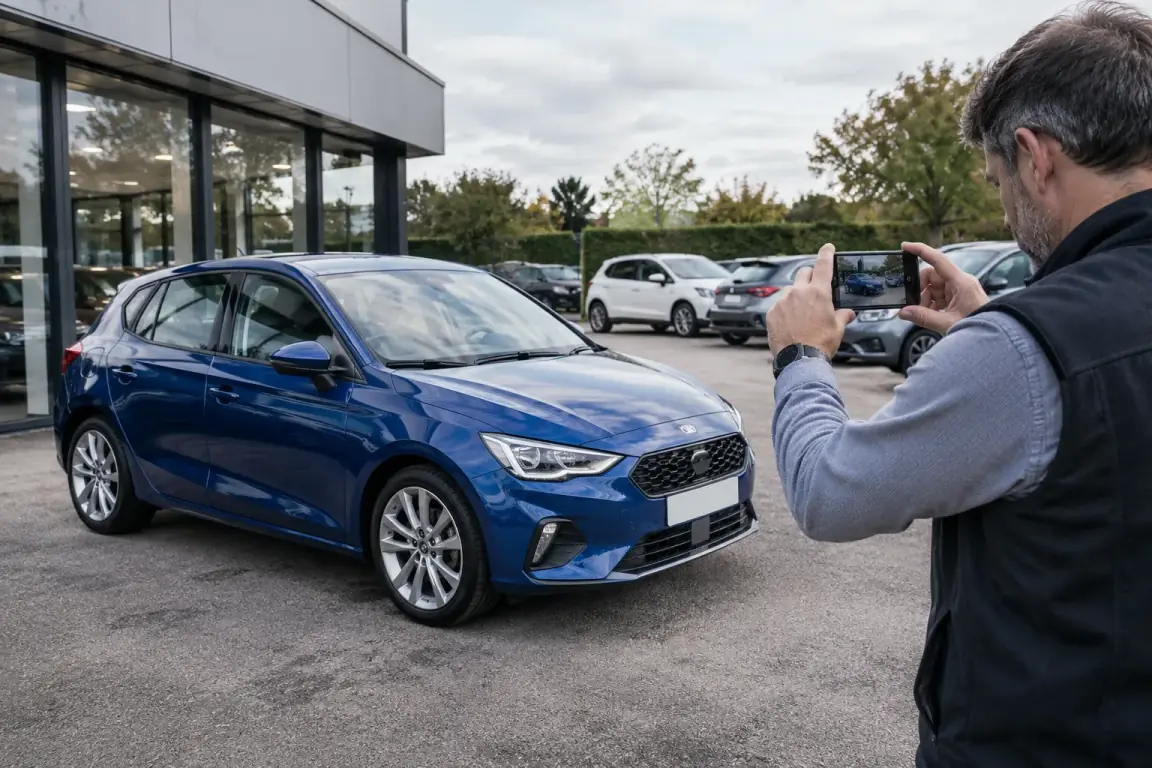
The main photo should show the whole car, correctly framed and without a distracting background. Blurred shots, harsh reflections or a dark interior tell the buyer nothing. Photos of faults, on the other hand, save the sales team time: the buyer either comes to the viewing with the right expectations or does not come at all.
Photo Checker from Carsdata checks the gallery before the advert goes live. It verifies that the recommended shots are included, rates the quality of each photo and detects blur, glare, poor framing as well as logos or watermarks. Finally, it lists the shots that need to be retaken.
The description must explain the car's condition and price
A long list of equipment is no substitute for information about the car. Adverts that generate no enquiries often fail to answer the questions buyers ask themselves before they even pick up the phone:
- What service history is available?
- What repairs or damage is the seller aware of?
- What exactly does the stated price include?
- Which equipment sets the car apart from the standard version?
- Where is the car located and when is it available for viewing?
Whatever sets the car apart from the rest belongs at the start of the description. Precise information about history, condition and equipment tells the buyer more than generic phrases about a well-kept car.
4. Is there demand for this version in the region?
Demand for a model does not apply equally to all its versions. The fact that the Golf is generally sought after does not tell you how quickly a particular engine with a given transmission and mileage will sell. And a national statistic does not provide a ready-made answer for every site.
Differences between markets are considerable. According to KBA data, Volkswagen accounted for 111,565 of the 533,447 used car ownership transfers in Germany in September 2026, or roughly a fifth of the market. In Italy in the same month, the Volkswagen Golf recorded 6,117 used car transfers and a 2.1% share, whereas the Fiat Panda recorded 24,796 transfers and an 8.7% share. A model that is among the most sought after in one market may be just one of many options in another.
It is similar with powertrains. According to ACI, petrol hybrids accounted for 12% of used car ownership transfers in Italy in September 2026, while battery electric cars made up just 1.4%. In Germany, electric cars have held a 5% share of used car ownership transfers since the start of 2026. In the Italian market, an electric car is therefore looking for a buyer within a much smaller group of prospects than a hybrid, and a long time online need not mean that something is wrong with the advert.
When looking for the cause, it is therefore essential to compare with the right group of cars. The table shows typical situations:
| Car on offer | What distorts the diagnosis | Appropriate comparison |
|---|---|---|
| Volkswagen Golf VII 1.5 TSI Evo ACT (110 kW, 2017–2019) | Mixing in other generations and engines | Same generation, power output and transmission |
| Škoda Octavia Scout 2.0 TDI (generation launched in 2020, 110 or 147 kW) | Mixing the two power versions, different mileage | Same power output, similar mileage and history |
| BMW 320d G20 (140 kW) | Overlooked differences in equipment and between rear-wheel and all-wheel drive | Similar specification and the same drivetrain |
| Toyota Yaris Hybrid (2020 generation, 1.5-litre engine) | Mixing in the previous generation or non-hybrid versions | Same generation and powertrain type |
If comparable offers are also attracting little interest, the problem lies in demand and new photos will not fix it. If, however, comparable cars are selling and your own offer is lagging behind, look for the cause in the price, in the content of the advert or in the way enquiries are handled.
Market Data from Carsdata shows supply, prices, time on market and estimated sales for the selected market and segment, with the sales estimate derived from how listings develop over time. This makes it possible to tell a problem with one car apart from a shift in demand across the whole segment.
5. A used car advert with no enquiries: what to measure and how to tell whether a change has worked
Keep a single record for each car that links the advertising channel, the dates of individual changes, the price and the results. Without a history of changes, you cannot tell whether interest increased after a new gallery, a price cut or paid highlighting.
| Metric | Calculation or record | What it shows |
|---|---|---|
| Listing open rate | Listing views ÷ impressions in search results × 100 | How well the offer attracts attention in search results |
| Enquiry rate | Enquiries ÷ listing views × 100 | How convincing the listing page is |
| Viewing rate | Viewings arranged ÷ enquiries × 100 | The quality of prospects and the sales team's responsiveness |
| Viewing outcome | Sales and reasons for rejection | Whether the advert matches the condition of the car |
One enquiry counts as one prospect interested in a given car, not the sum of their phone call and other messages. Record clicks on the phone number separately from calls that actually took place.
Compare results before and after a change over periods of the same length in whole weeks, so that the difference between weekdays and weekends does not distort them. For cars that few people search for, track a longer period, because a single enquiry shifts the result considerably. Ideally, each adjustment should change only one main element: the main photo, the gallery or the price. Obviously incorrect data, however, should be corrected immediately, even if the test becomes less clean as a result.
The age of the advert also belongs in the record. According to AUTOHAUS, the average advertising period among the monitored listings on German portals was 56 days in September 2026. For an individual car, however, a comparison with the same segment says more than one with the whole market. Buyers who follow the market recognise a car that has been online much longer than comparable cars, and they read a long time on offer as a sign that something is wrong with it. Renewing the advert must therefore not overwrite the internal date of first publication. Alongside it, record the date the car was taken over: the preparation time before the advert goes live counts towards days in stock, but it has nothing to do with how the advert performs.
What to watch out for
- A blanket discount without a diagnosis. It eats into the margin even on cars whose real problem is their categorisation or presentation.
- Comparing different metrics. An impression in search results is not the same as a listing view, and each portal calculates its metrics slightly differently. Compare results within a single channel.
- Judging by traffic for the whole site. The stock mix and paid promotion distort the result, so compare similar offers on the same channel.
- Undisclosed faults. They may generate more contacts, but the rejection is merely postponed until the viewing and uses up the sales team's time.
- Slow communication. Unanswered questions or unclear availability of the car will undermine even a well-prepared advert.
Carsdata: every car compared with the whole market
A manual comparison on one portal shows only part of the competing offers and takes time for every car. The Carsdata platform collects used car listings and auction offers from European portals, removes duplicates and standardises vehicle data. Decisions on price and advert are therefore based on the whole market, not on a look at a single portal.
- Stock Report compares the entire stock with the market and recommends a price for each car. It flags the cars that need repricing, additional equipment in the advert, new photos or a move to the correct category. It also shows stock value and days in stock, which makes it suitable for dealer groups as well.
- Price Report estimates the realistic selling price of a specific car based on comparable cars selected by make, model, age, mileage, equipment and region. It adds a price range, a confidence level for the estimate and the expected time to sell. It values option packs individually according to how they affect the market price, not with a flat percentage.
Data and results reach the dealer's own systems via API, and Carsdata is also natively integrated with Omnetic DMS. Decisions on repricing and changes to adverts remain with the dealer's team.
You can see what such a diagnosis would look like for your stock in a Carsdata demo. Simply book one.
FAQ
Will paid highlighting of the advert help?
Highlighting brings more visits, so it only helps an offer that has correct data and convincing content. If the advert gets a lot of traffic but hardly any enquiries, fix the problem in the listing page first.
How do you compare a rare version for which there are few comparable cars on the market?
Widen the comparison step by step: first to other regions, then to cars with slightly different age or mileage. Then reflect each of these differences in the price. If you lumped all versions of the model into a single average, you would reach the wrong conclusion about the price.
Could the season be the cause?
Yes, especially for cars used seasonally, such as convertibles or four-wheel-drive models. A seasonal downturn, however, also affects similar offers, whereas a problem with one advert shows up only in that advert. Compare the same time of year and the same segment, therefore, not overall market results.
When should a car be reduced in price, and when should it be sold through another route?
Repricing becomes the next step once the advert is in order, there is demand for the version and comparable cars are cheaper. Rules and timing for price reductions, and how to decide whether to sell a car to the trade or send it to auction, are covered in the article Aged used car stock: when to cut the price and when to change the sales channel.
Sources
- https://www.cebia.cz/pruvodce/jak-vytvorit-inzerat-na-prodej-auta
- https://www.autohaus.de/nachrichten/gw-trends/ebrauchtwagenmarkt-unter-druck-bestaende-steigen-preise-sinken-3925325
- https://www.kfz-innung-mittelbaden.de/newsletter-10-2026/dat-barometer-im-september-2026-hier-schwerpunkt-kba/
- https://aci.gov.it/comunicati-stampa/mercato-a-settembre-ogni-100-auto-nuove-vendute-213-usate/
- https://www.lautomobile.aci.it/attualita/auto-usate-piu-vendute-in-italia-a-settembre-2026/
- https://www.volkswagen-newsroom.com/en/vehicle-data-golf-7-profile-20039
- https://cdn.skoda-storyboard.com/2020/11/OCTAVIA-SCOUT-Motory.pdf
- https://www.motoreport.de/3er-bmw-2019-320d-im-test/
- https://www.toyotanews.eu/cs/press-kit-cz/1739-item-press-kit-zbrusu-nova-toyota-yaris-2020
- https://carsdata.com/about
- https://carsdata.com/products/stock-report
- https://carsdata.com/products/price-report
- https://carsdata.com/products/photo-checker
- https://carsdata.com/products/market-data
- https://o-seznam.cz/napoveda/sauto/prihlaseni-jednorazova-inzerce/vytvoreni-uprava-inzeratu/
- https://www.netconnection-gmbh.de/ratgeber/standzeiten-im-autohandel-was-jeder-tag-auf-dem-hof-wirklich-kostet
- https://fahrzeugstatistik.de/gebrauchtwagen